
One equation that reads a molecule and tells you what a formulation still needs.
Every substance — peptide, excipient, unknown powder — becomes a vector. Every recipe becomes a need. The Dicoias Ψ equation measures the gap between them: structure in, property out, certainty honestly capped. This is the private mathematical language Panacea Bio Chem built for its formulation work — mathematics as the universal formulation language.
What Ψ computes
Ψ is a structure→property intelligence. It does not simulate a beaker — it maps molecular structure into a shared descriptor space, places the result on capability axes, and measures how far a whole formulation sits from what its peptide actually needs. Four pillars carry the weight.
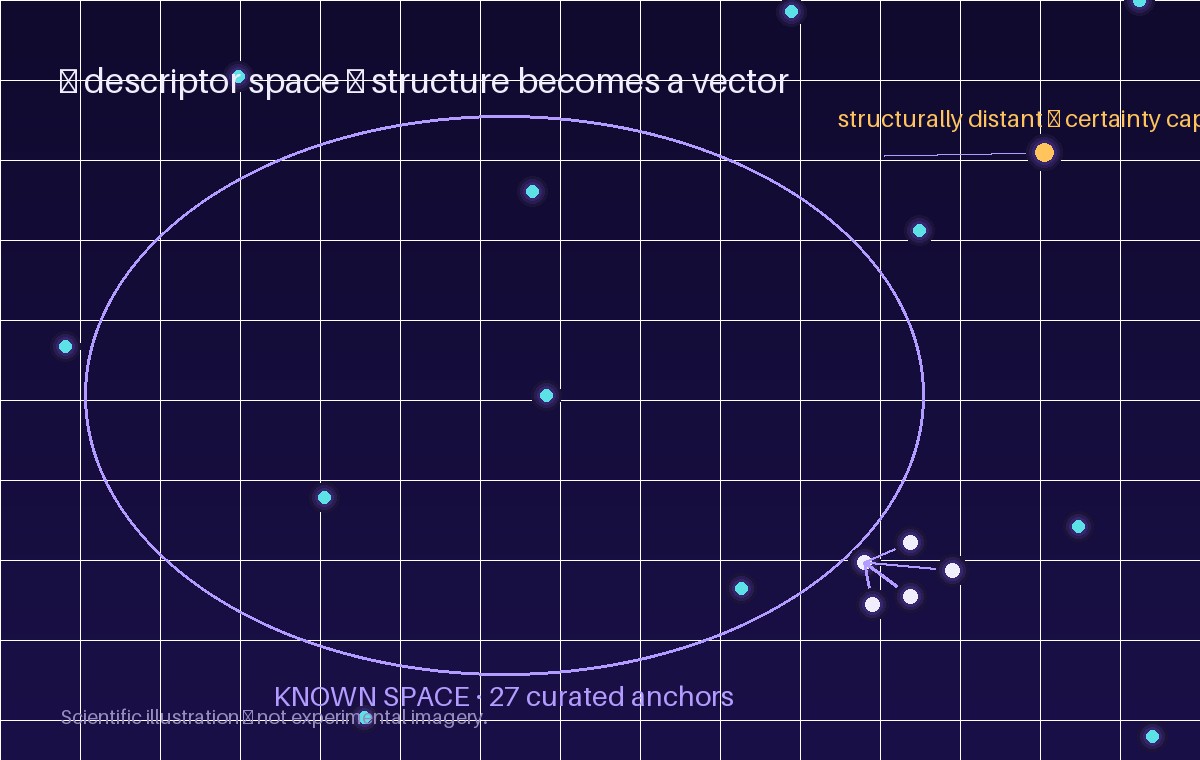
Structure → vector
The W6 "Mendeleev" engine takes a canonical SMILES and derives a 26-dimensional descriptor vector Φ — electrostatics, hydrophobic patterning, chemical liability, solid-state behaviour — then maps Φ onto capability axes Λ with a ridge-NNLS model calibrated on 27 curated anchor substances. 68 of 101 periodic-table entries are derived this way.
Whole-recipe scoring
A formulation is a set, not a molecule. Ψ combines every ingredient's effective capability into Λ_S and scores the shortfall Δ, the harmful overshoot C⁻ and the oversupply E against the peptide's need vector N — with β > α, so doing harm costs more than falling short. The score maps through 100 × e−Ψ/τ with τ = 0.615.
Quantum descriptors, for real
A display-only sidecar computes frontier-orbital descriptors — HOMO, LUMO, gap, ionisation potential, electron affinity — using a real GFN2-xTB backend (xtb 6.7.1, run as a subprocess with hard timeouts and typed failure states). Empirical RDKit descriptors and SMARTS-based proxies are labelled as exactly what they are.
Bayesian memory
W7 treats every literature prior as a Beta distribution and updates it conjugately with each real Panacea run — posteriors live in an overlay, frozen literature priors are never mutated, and the 90% credible interval is the headline number. Certainty is earned run by run, never asserted.
The eight waves of the stack
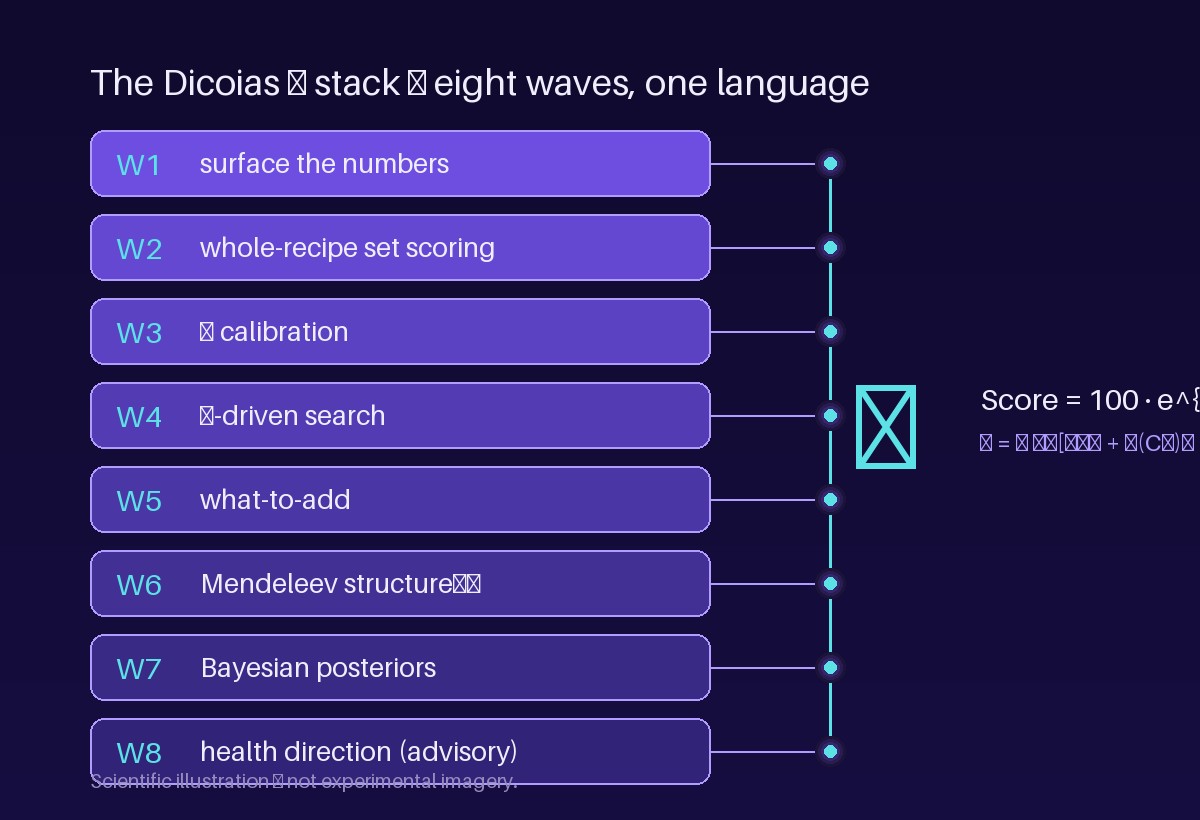
Ψ is not one formula but a layered architecture, built in eight waves — each one display-only and advisory, each one gated. The full depth is on The Equation page.
Surface the numbers
Every vector, every score, every driver made visible — a periodic table of substances where nothing is computed-then-hidden.
Set scoring
Whole recipes scored as sets with an Occam tie-break — the mixture, not the molecule, is the unit of truth.
τ calibration
The score scale τ = 0.615, with provenance, turning raw Ψ into an interpretable 0–100 readout.
Ψ-driven search
Greedy forward selection refined by deterministic simulated annealing, under an osmolality budget — advisory, off by default.
What to add
Backward Λ-space inversion: which excipient, and roughly how much, closes each gap — a proposal, never an instruction.
Mendeleev engine
Structure→Λ derivation for substances Ψ has never seen — plus the honest electronic sidecar and the real GFN2-xTB backend.
Bayesian posteriors
Beta-Bernoulli conjugate updates from real runs; the credible interval tightens as evidence accumulates.
Health direction
Per-axis structural directions with certainty hard-capped by known-space distance — guidance, never a verdict about people.
Ask Dicoias
A question engine: Ψ becomes a family of question operators — stability, solubility, redox, comfort, fitness, similarity, health direction, unknown risk — each returning score, certainty, drivers, missing data and next action.
The honesty doctrine
A number you cannot defend is worse than no number. Ψ is built so that false certainty is structurally impossible — three mechanisms do the work, and the full doctrine lives on the Honesty page.
Honest declines
Unresolvable structure, ambiguous identity, missing quantum backend, uncurated biological reference set — each returns a typed decline with the reason attached. The system says "I cannot know this" in the same voice it says everything else. Never a fabricated number.
Certainty caps
The known-space distance gate measures how far a substance sits from the 27 curated anchors in descriptor space. Farther away means a harder ceiling on certainty — down to a 0.15 cap for structurally alien substances. Novelty automatically deflates the readout.
The display-only firewall
The entire Ψ spine is isolated from the formulation engine: it writes nothing, applies nothing, mutates no seed and touches no actuator. Ψ informs the operator; the operator — and only the operator — decides.
Evidence, labelled
Every number carries its provenance: literature prior, derived-from-structure, or bench-calibrated from real Panacea runs. The label travels with the value wherever it is shown.
A private computational alchemy
Panacea Bio Chem does not sell software. Ψ exists for one reason: so that when Panacea formulates — a peptide, an amino-acid chain, a lyophilized cake — the question "what does this molecule still need?" has a mathematical answer before the first bench run, and an honest boundary drawn around what mathematics cannot yet say. It is a private computational alchemy: structure transmuted into property, property into guidance, guidance into better questions for the bench.
It runs inside S3Pulse, Panacea's formulation environment, beside the instruments it advises — and it stays in its lane: computational intelligence that informs, never an oracle that decides.
Private system · displayed publicly for scientific context · advisory by construction
"A formulation is a sentence written in molecules. For years we read those sentences by intuition and by bench time. Ψ is the grammar we wrote down: every substance a vector, every need a direction, every claim carrying the evidence that earned it. The part I am proudest of is not what it computes — it is that when the data is not there, the system says so, plainly, instead of inventing a number."
Bogdan Dicoias — Biochemist · AAC Designer · Panacea Bio Chem Ltd
Frequently asked questions
What is the Dicoias Ψ equation?
Panacea Bio Chem's formulation-compatibility objective: every substance is reduced to a capability vector, a recipe's needs become a need vector, and Ψ measures the squared distance between them. The score is 100 × e−Ψ/τ.
How does Ψ handle a substance it has never seen?
Through the W6 Mendeleev engine: canonical SMILES → 26-dimensional descriptor vector → ridge-NNLS mapping calibrated on 27 curated anchors. Unresolvable structures get a typed decline, never a guessed vector.
Does Ψ use quantum chemistry?
Yes — a display-only sidecar computes HOMO/LUMO and derived quantities with a real GFN2-xTB backend (xtb 6.7.1). Without a backend or a structure, those fields are honest declines, not numbers.
Trending in the field
Recent developments in the field — refreshed 2026-10-25 by Panacea Bio Chem.
- Multi-Temperature VOCs + OH Rate Coefficients Prediction via GCN Constrained by the Arrhenius Equation — PubMed, 2026 Sep 24
- Soil Sorption Estimator (SSE): Read-Across-Based Predictions of Soil Organic Carbon Partition Coefficient (Log Koc) and Validation Using Multiple External Sets — PubMed, 2026 Sep 29
- Activity Landscape Roughness Anticipates Machine-Learning Reliability Across Environmental Chemistry Endpoints — PubMed, 2026 Sep 29
- MSIonization: A Machine Learning Tool for Ionization Mode Prediction of Small Molecules — PubMed, 2026 Sep 29