
The Ψ stack, wave by wave
Ψ began as a locked mathematical specification — need axes, capability axes, one objective — and grew into a full architecture in eight waves. Every wave is display-only and advisory: each adds a way to see or derive, none adds a way to act. The objective at the centre never changed:
Δ = unmet need (shortfall) · C⁻ = harmful capability magnitude · E = oversupply · α=1.0, β=2.0, γ=0.15 — β > α: do no harm costs double. Lower Ψ is better; infeasible is +∞.
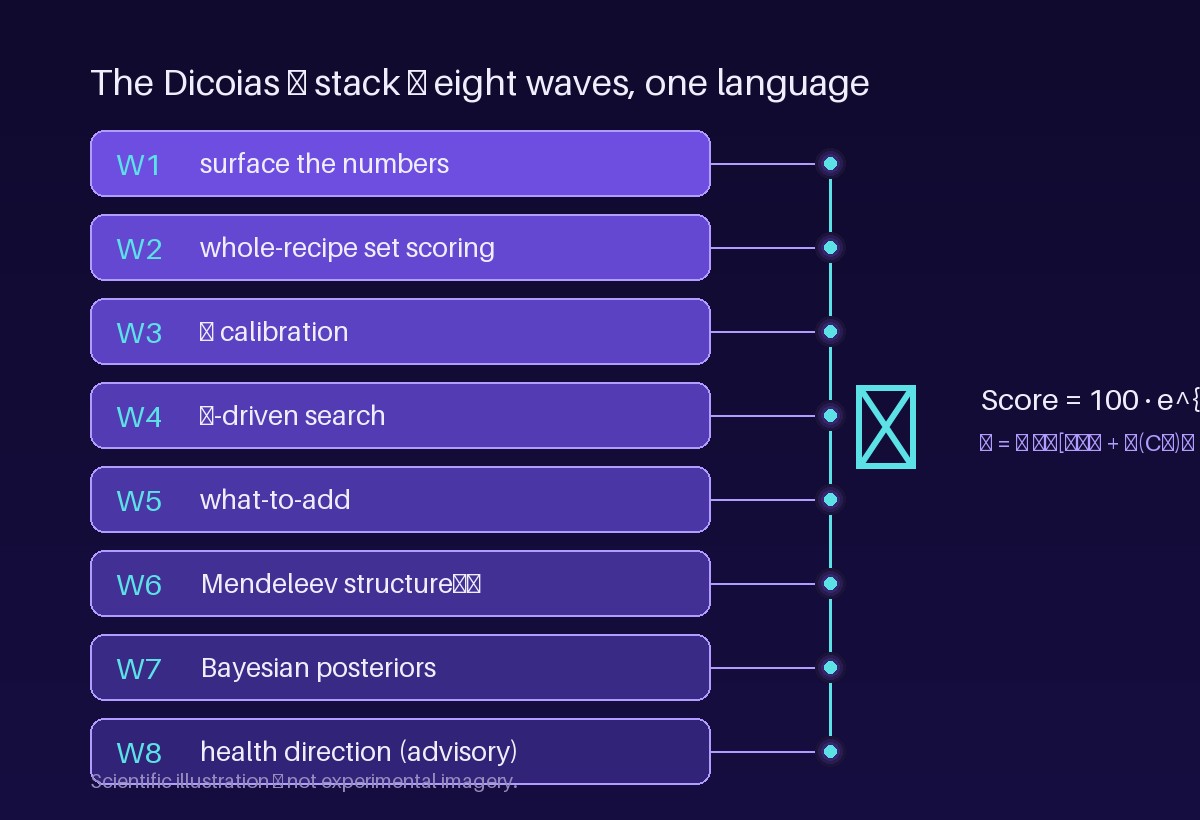
Surface the numbers — the periodic table of substances
The bridge between Ψ and the bench already computed need vectors, peptide signatures and full Ψ results — and then discarded them. W1 surfaced what existed: every substance rendered as a card in a "periodic table" view, every vector and score visible with its evidence label. Copy, not compute — the firewall stayed byte-identical because nothing new was calculated, only shown.
Whole-recipe set scoring
A formulation is a set. W2 lifted the single-additive cap so Ψ scores the mixture: each ingredient's effective capability sums into Λ_S = clip(Σ Λ_x_eff), and the set is ranked against the need vector with an Occam tie-break — fewer ingredients win at equal Ψ. The mathematics already existed in the core; W2 was an adapter wave, not new math.
τ — the calibration constant
The score mapping Score = 100 × e−Ψ/τ shipped with τ unsettled — a deliberate null in the locked specification, awaiting population calibration. W3 filled it: τ = 0.615, with provenance recorded alongside. A raw energy becomes an interpretable 0–100 readout, monotone decreasing, context-independent.
Ψ-driven search — the authority flip that never flips
Given a recipe, which additive set minimises Ψ? W4 answers with a two-stage search: greedy forward selection, then simulated annealing seeded deterministically (SHA-256 of the recipe inputs), under a soft osmolality budget with a hard ceiling that infeasible sets can never cross. It ranks, proposes and stops. The layer sits behind an explicit off-switch — Ψ advises the search; it does not run the lab.
What to add — backward Λ-space inversion
When Ψ is off-target, W5 inverts the question: for each need dimension with a shortfall Δ_j, which excipient carries Λ_x[j] > 0, and roughly how much unit-mass closes the gap? The v1 inversion is an explicit linear approximation at the operating point — it does not pretend to solve true non-linear chemistry, and every result ships as a governance proposal: a correction card the operator may adopt, adapt or ignore.
The Mendeleev engine — structure → Λ for substances never seen
The crown jewel. Before Mendeleev's table, chemistry described each element alone; after it, position predicted property. W6 does the same for formulation:
- Resolve — an identifier becomes a canonical SMILES, or the wave declines (ambiguous name, formula without structure, unresolvable input — each a typed decline, never a guess).
- Describe — RDKit analysis produces Φ, a frozen 26-dimensional descriptor vector spanning electrostatics, hydrophobic patterning, chemical liability and solid-state behaviour.
- Map — a ridge-regularised non-negative least squares model, calibrated on 27 curated anchor substances with known capabilities, maps Φ → Λ with masks and constraints. Leave-one-out checks passed on 9 of 12 held-out axes; the three misses are flagged and their certainty capped, not hidden.
- Tag — every derived vector carries the label DERIVED_MENDELEEV_v1 and a derivation certainty ceiling below the curated anchors'. 68 of 101 periodic-table entries are derived this way.
The honest quantum sidecar — real GFN2-xTB
Electronic structure got its own honesty tiers, attached to the same structure pass, never entering Φ, Λ or any posterior:
- COMPUTED — real empirical descriptors from the structure itself: Gasteiger partial charges, EState values, valence and radical electron counts.
- PROXY — SMARTS and group-based structural indicators (electrophilicity, nucleophilicity, metal-binding, oxidation liability), labelled "proxy" wherever shown. Never presented as quantum quantities.
- UNAVAILABLE → COMPUTED, honestly — true frontier-orbital quantities (HOMO, LUMO, gap, ionisation potential, electron affinity) began as typed declines — needs_qm_backend, never a faked number. The real backend then landed: GFN2-xTB via the xtb 6.7.1 binary, run as a subprocess with a hard wall-clock timeout, parsing the orbital block from stdout, converting Hartree to electron-volts with the CODATA constant. A failed, timed-out or unparseable run raises a typed error and becomes an honest unavailable state — the failure modes are part of the schema.
Known-space distance — the structural certainty gate
How far is this substance from everything Ψ actually knows? W6b answers in Φ space: a standardised Euclidean distance to the curated 27-anchor known set, normalised by the pinned 95th-percentile scale of the anchors' own pairwise distances (12.299481, provenance-locked by test — it cannot drift silently). The distance d drives a certainty cap: cap(d) = clamp(1 − d, 0.15, 1.0). The 0.15 floor is the alien ceiling — a structurally alien substance can never wear high certainty, no matter how attractive its other features look. The cap only ever lowers a certainty.
Bayesian calibration — certainty earned from real runs
Literature priors are knowledge, but Panacea's own bench is evidence. W7 maps each prior to Beta pseudo-counts and updates conjugately with fractional pass/fail counts from real S3Pulse runs: (α₀ + passes, β₀ + fails). Out come closed-form posteriors with a 90% credible interval — computed by scipy's beta ppf where available, else a deterministic bisection of the regularised incomplete beta function, the two asserted to agree to 1e-6. Posteriors live in a gitignored overlay; the frozen literature priors are never mutated, and the seed file stays byte-identical after any write. The interval width is the headline honesty number — it tightens with evidence and is never collapsed into a badge.
Health direction — guidance with a hard ceiling
The last and most gated wave. W8 reads the electronic sidecar into per-axis structural directions — redox balance (signed: reducing ↔ oxidative-burden), reactive burden (one-sided electrophilic load), metal-interaction tendency — each travelling with its own certainty, hard-capped by the W6b distance gate and by an explicit structural-only ceiling of 0.6. There is no combined "health score": that would be a verdict, and Ψ issues none. The biological-resemblance axes (mitochondrial, anti-inflammatory) ship declined — they need an operator-curated, property-tagged reference set, and the system does not invent biology tags. A real bodily effect needs lab and clinical evidence; W8 says exactly that, on the card, every time.
Ask Dicoias — the question engine
One number per question, not one per substance. Ψ becomes a family of question operators — Ψ_stability, Ψ_solubility, Ψ_redox, Ψ_injectable_comfort, Ψ_formulation_fitness, Ψ_biological_similarity, Ψ_health_direction, Ψ_unknown_risk — each returning a uniform card: score, certainty, drivers, missing data, next action. The card format is the doctrine in miniature: what the system thinks, how strongly it may think it, why, what it lacks, and what would change its mind.